



Decaf green tea is not caffeine-free, and no maker claims it is. A standard 8-ounce cup holds roughly 2 to 5 mg, against about 25 mg in the regular version. That is a genuine drop.
The harder question sits on the other side of the label. Caffeine does not leave the leaf alone. Pressurized gas, solvent, or hot water pulls catechins out alongside it, and one peer-reviewed trial measured that second loss at close to 90 percent.
Decaf green tea at a glance
| Drink, 8 fl oz cup | Typical caffeine | What that means |
|---|---|---|
| Green tea, standard | About 25 mg | The FDA lists 37 mg in a 12 fl oz serving |
| Decaffeinated leaf or bag | 2 to 5 mg | Roughly 95 to 98 percent removed, never all of it |
| Decaf coffee | 2 to 5 mg | Similar residue, usually poured in bigger servings |
| Kukicha or hojicha | Roughly 8 to 20 mg | Naturally lower, nothing extracted or added |
| Rooibos or peppermint | 0 mg | Not tea at all, so there is no caffeine to strip |
Key takeaways
- Decaf keeps a trace of caffeine, near a tenth of the original dose.
- Three processes dominate: supercritical CO2, ethyl acetate and a water soak.
- Catechins pay the bill. A 2022 trial recorded a 90.9 percent fall in EGCG.
- Theanine, the amino acid behind the calm feeling, drops as well.
- If caffeine is your only worry, a naturally low leaf may serve you better.
How much caffeine survives decaffeination?
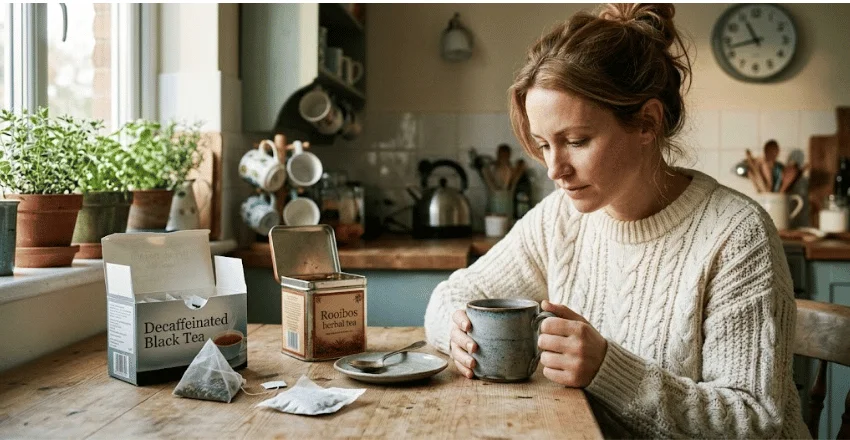
A decaffeinated cup carries about 2 to 5 mg of caffeine, roughly a tenth of what the untreated leaf gives you. Commercial processes take out 95 to 98 percent, not every last molecule. For most drinkers, that residue is meaningless. For a small group with real sensitivity, it is still a measurable dose.
Your own cup can land above or below that band. Steep a bag for five minutes and you extract more of whatever is left than a two-minute steep does. Fine dust in a cheap teabag gives up its contents faster than whole leaf. Two bags in one mug doubles the number, obviously enough, and plenty of people do exactly that because decaf tastes thin.
Anyone chasing zero should stop reading the tea aisle. Rooibos, peppermint and chamomile start at nothing, so nothing has to be taken away.
Three ways the caffeine comes out
Every commercial method works on the same principle. Something is pushed through the wet leaf, caffeine dissolves into it, and the leaf is dried again. What separates the methods is how selective that something is.
| Method | How it works | Where it hurts | How it reads on the pack |
|---|---|---|---|
| Supercritical CO2 | Carbon dioxide held under high pressure behaves as a selective solvent | Sold as the gentle option, though measured catechin loss in green leaf is heavy | “CO2 decaffeinated”, “carbon dioxide process” |
| Ethyl acetate | A solvent that also occurs in ripening fruit, washed through the leaf | Cheapest and most common, and the hardest on aroma | “Naturally decaffeinated” |
| Water process | Hot water plus carbon filtration, no added solvent | Kind to the chemistry, rough on flavor, rare in tea | “Water processed”, “chemical free” |
The water process is the one people assume is everywhere, because coffee drinkers know it from the Swiss Water name. In tea it stays uncommon. Water is an unfussy solvent that removes plenty besides caffeine. Equipment, volume and storing water efficiently at that scale all add cost a bagged product cannot carry.
Then there is methylene chloride, the solvent that generates the most alarm online. According to federal food additive rules, its residue cap is 10 parts per million, or 0.001 percent. That cap covers decaffeinated roasted coffee and soluble coffee extract. Tea is not named in the section. The scare belongs to a different drink.
What the process costs in catechins
Here is the part page one skips.
A 2022 study in the journal Foods decaffeinated green and black tea made from the same fresh leaves, using supercritical CO2. The researchers removed 98.2 percent of the caffeine from the green batch. In the same batch, EGCG fell by 90.9 percent, epicatechin gallate by 96.0 percent and epigallocatechin by 66.2 percent.
EGCG is the compound most of the health research rests on. Losing nine-tenths of it is not a rounding error.
Theanine took a hit too. That amino acid produces the settled, alert feeling regular drinkers describe, and the same paper recorded its loss in both teas. The authors went further: because the treated green leaf lost so much bitterness and astringency, tasters liked it less, and they concluded the method suits black tea better.
One trial is one trial, and results vary by leaf, pressure, and run time. Still, nobody on the first page of results puts a number on the trade at all, and the number is not small.
Is it safe at night, in pregnancy or with medication?
For a healthy adult, the residue is noise. According to the FDA, 400 mg a day is not generally associated with negative effects in healthy adults. Its table puts 37 mg in a 12-fluid-ounce serving of the caffeinated leaf. Three decaf cups in an evening might total 15 mg.
Pregnancy has a tighter ceiling. Committee guidance from the American College of Obstetricians and Gynecologists was reaffirmed in 2023. It states that moderate consumption under 200 mg per day does not appear to be a major factor in miscarriage or preterm birth. A few milligrams from a decaf mug will not move that budget—coffee and cola will.
Sleep is usually a habit problem rather than a chemistry problem. A late cup of anything hot near bedtime signals wind down, and a couple of milligrams is not what keeps you staring at the ceiling.
One caution worth naming. Catechins interact with some medications, and decaffeinated leaf still contains them, fewer of them but not none. If you take blood thinners or thyroid medication, ask your pharmacist rather than a tea brand.
How to tell which method your brand used
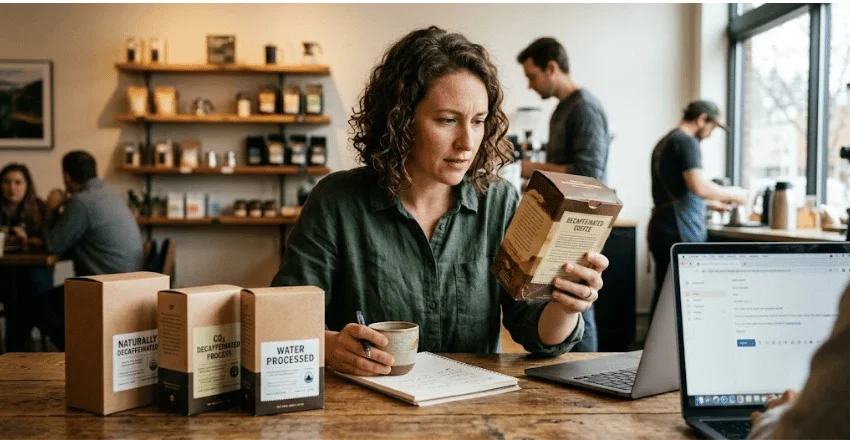
Most boxes say “decaffeinated” and stop. You can usually work out the rest:
- “Naturally decaffeinated” almost always means ethyl acetate, because the solvent occurs in fruit.
- “CO2 decaffeinated” or “carbon dioxide process” is spelled out, since brands pay for it and want credit.
- “Water processed” or “chemical free” points to the water soak, which is rare enough to be worth checking.
- Silence usually means ethyl acetate, the default at commodity prices.
- Email the brand and ask two questions: which method, and what residual caffeine they measure per serving. A maker that tests will answer in a day.
Price hints at the answer too. Carbon dioxide plants are expensive to run, so boxes that advertise the method usually sit a few dollars above the commodity decaf beside them. Anyone unwilling to answer that second question is telling you something.
Naturally low caffeine leaves are worth a look.
Decaffeination is not the only route to a quiet cup. Several Japanese styles start lower because of what part of the plant they use and how it is treated.
- Hojicha is roasted, often from later harvests, and tastes of toast and caramel rather than grass.
- Kukicha is built from stems and twigs, which hold far less caffeine than young buds.
- Genmaicha cuts the leaf with toasted rice, so a spoonful contains less leaf to begin with.
None of these hits the 2 to 5 mg band, and none of them has been stripped of nine-tenths of its EGCG either. That is the trade in reverse. Serve hojicha cold after dinner beside a scoop of ice cream, and you will not miss the decaf.
Brewing decaf so it still tastes like tea.
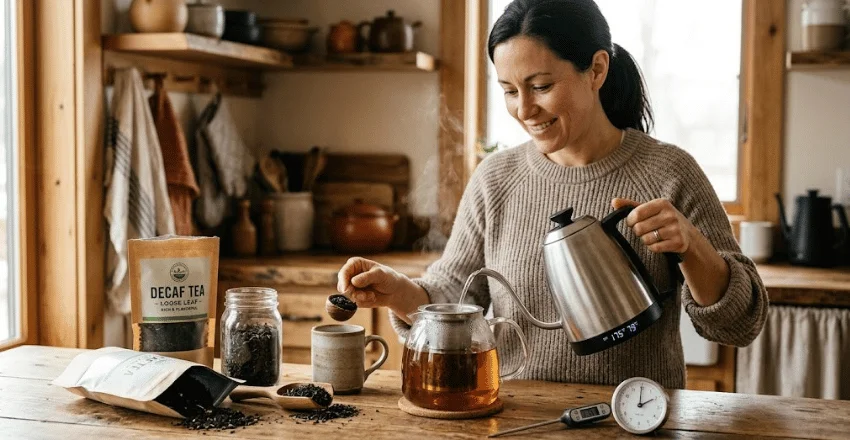
Treated leaf has lost structure, so it needs help. Use water around 175°F, never boiling, and give it two minutes rather than four. Add a little more leaf than the packet suggests, since the bitterness that would normally balance it is gone.
Loose leaf beats bags here by a wide margin. Whole leaf survives processing better than dust does.
Brewing a pitcher for the fridge? Chill it quickly and finish it within two days. The logic that governs commercial cold rooms holds in a home refrigerator too, since steady temperature protects flavor and slows spoilage.
Rinsing leaves in your kettle for 30 seconds does not decaffeinate anything. That trick gets repeated constantly, and it fails for a simple reason. That 98.2 percent figure above came from carbon dioxide held at industrial pressure, not from a hot rinse. You will wash away aroma and keep most of the caffeine.
The verdict
Buy it for the taste and the habit, not for a health halo the processing has already stripped. Turn the box over before it reaches your cart. If the method is not printed, send the brand one email asking which process they use and what residual caffeine they measure, then buy the one that answers.
Frequently asked questions
No. Expect 2 to 5 mg per 8-ounce cup. Caffeine-free means zero, and only herbal infusions such as rooibos or chamomile qualify.
Yes, at reduced levels. A 2022 Foods trial recorded a 90.9 percent drop in EGCG after supercritical CO2 treatment. That makes a treated cup weaker evidence for the health claims attached to the untreated leaf.
CO2 has the better reputation and usually the better flavor. The catechin data complicates that story, so choose on taste and price, and treat any antioxidant claim on a decaf box with suspicion.
Almost certainly. A few milligrams sit far below the level that disturbs sleep for most adults, though anyone extremely sensitive should test it on a quiet evening first.
It is, if you want the ritual and the flavor without the stimulant. If you are drinking it purely for antioxidants, the numbers argue for a naturally low-caffeine leaf instead.
