


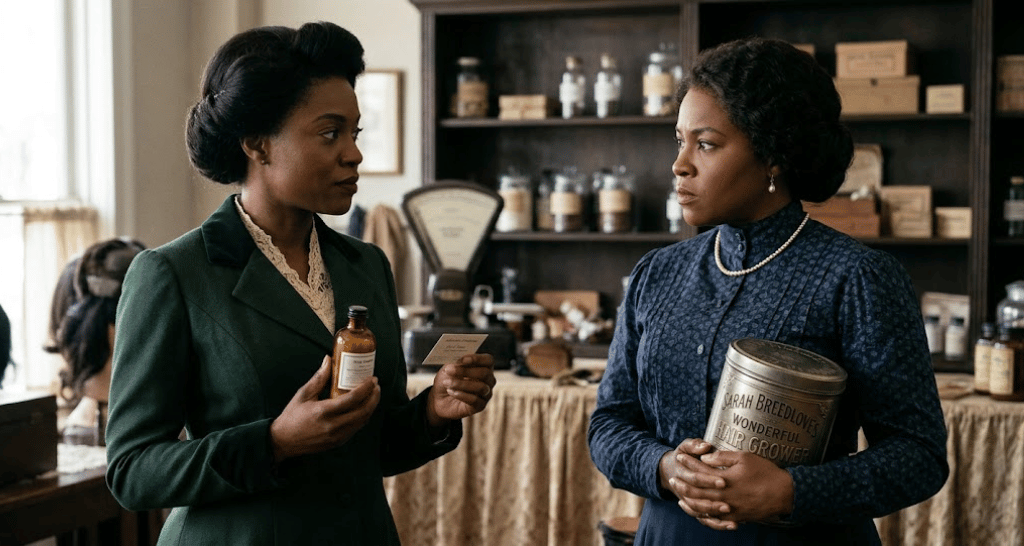
Viewers of Netflix’s Self Made often search for Addie Munroe after watching Madam C.J. Walker battle her business rival. The character feels historical because the limited series draws heavily on real people. Yet Addie was created for television, though her story draws heavily on entrepreneur Annie Turnbo Malone.
Direct answer: Addie Munroe is not a documented historical person from Madam C.J. Walker’s life. Netflix created the character for Self Made, with Annie Turnbo Malone as the clearest real-world inspiration. Malone was a major Black hair-care entrepreneur, educator, employer, and philanthropist whose real relationship with Walker was considerably more complex.
Quick Facts
| Detail | Answer |
|---|---|
| Character | Addie, Madam C.J. Walker’s business rival |
| Appears in | Self Made: Inspired by the Life of Madam C.J. Walker |
| Series release | March 20, 2020 |
| Actress | Carmen Ejogo |
| Historical person? | No, not under that identity |
| Main historical inspiration | Annie Turnbo Malone |
| Malone’s business | Poro Company and Poro College |
| Connection to Walker | Walker worked as a sales agent for Malone |
| Major difference | The television rivalry was heavily dramatized |
Netflix identifies Carmen Ejogo as Walker’s business rival in the four-part 2020 limited series. The platform describes the program as inspired by A’Lelia Bundles’ book about Walker. That wording matters because the production uses dramatic invention alongside documented history.
Was Addie Munroe a Real Person?
No historical evidence establishes the television character as a real woman who held that role in Walker’s life. Contemporary reporting about Self Made quickly highlighted this distinction after the series premiered. The fictional rival instead combines historical inspiration with storytelling choices made for the drama.
The strongest real-life connection is Annie Turnbo Malone, one of America’s pioneering Black beauty entrepreneurs. Malone built a hair-care company before Walker established her own famous enterprise. Walker also sold Malone’s products before creating a competing business.
Who Was Annie Turnbo Malone?
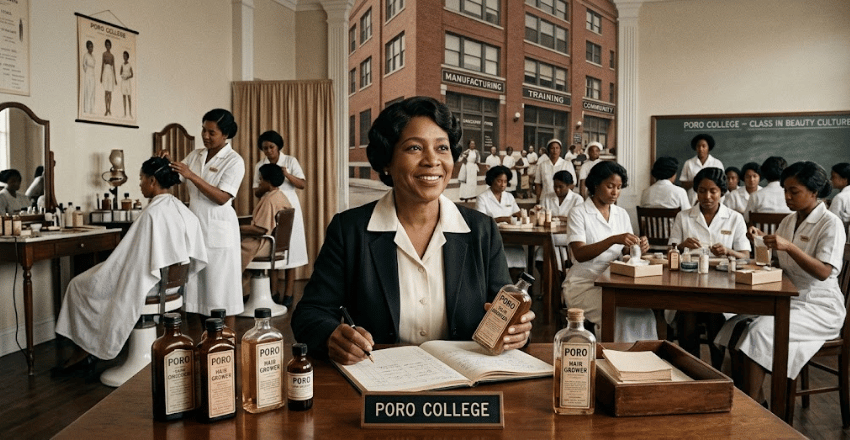
Annie Turnbo Malone was born in Illinois in 1869 to parents who had previously been enslaved. She developed products designed for Black hair and scalp care during the late nineteenth and early twentieth centuries. Her commercial success eventually made her one of the era’s wealthiest Black businesswomen.
Malone moved to Missouri and expanded the Poro business into a large beauty enterprise. Poro included products, professional training, employment, and a large network of sales agents. Her work gave thousands of Black women opportunities in an industry that offered relatively few professional paths.
Poro College became an important part of that work. The institution combined beauty education with manufacturing, offices, community facilities, and social spaces. Historical accounts describe it as both a business center and a significant institution within Black St. Louis.
How Annie Malone and Madam C.J. Walker Were Connected
Sarah Breedlove, later known as Madam C.J. Walker, had a genuine professional connection with Malone. Smithsonian records state that Walker worked as a sales agent for Malone’s company. She later moved to Denver and began developing and selling products under her own name.
That history gives Self Made a factual foundation for presenting two competing beauty entrepreneurs. Still, the series turns their business relationship into a much more personal conflict. Its repeated confrontations, insults, and aggressive sabotage should not be treated as a documentary record.
The distinction also changes how viewers understand Malone’s importance. She wasn’t simply an obstacle in Walker’s rise. She had already built an influential company, training system, and professional network.
What Self Made Changed for Television
The Netflix series presents Addie as a polished and highly competitive entrepreneur who dismisses Sarah’s ambitions. Their relationship soon becomes one of the drama’s central conflicts. Netflix’s first episode even describes Sarah as trying to sell Addie’s product before being rejected.
Historical sources tell a different story on that specific point. Walker did work as a Poro sales agent, rather than being completely excluded from Malone’s sales organization. That difference makes the television rejection scene a clear example of dramatic compression and invention.
The show also uses the rivalry to explore colorism and Black beauty standards. Those subjects have real historical importance, but the character should not become a substitute for Malone herself. Critics and historians raised similar concerns after the series reached Netflix audiences.
Why Annie Malone’s Real Achievements Matter
Malone’s achievements stretch well beyond her connection with Walker. She created a large business, trained beauty professionals, and helped expand economic opportunities for Black women. Smithsonian historians describe both women as pioneers who helped shape America’s Black beauty industry.
Her business also developed into a much broader institution. Poro College provided professional instruction while supporting commercial, cultural, and community activity in St. Louis. Historical accounts record classrooms, manufacturing facilities, gathering spaces, and services within the complex.
Malone was also known for philanthropy and community support. Historical organizations document donations to educational institutions and Black civic organizations. Her legacy therefore combines entrepreneurship, vocational training, institution building, and charitable work.
Why the Fictional Rival Can Create Confusion
Biographical dramas often combine events or reshape relationships to create a clearer television narrative. That technique can help audiences follow complicated history within a limited running time. It can also create lasting misconceptions when a fictional character closely resembles a real person.
That problem matters here because Malone deserves attention on her own terms. Reducing her to Walker’s jealous rival misses decades of entrepreneurship and community work. The historical record instead shows two influential women whose careers intersected within a growing Black beauty industry.
Readers who enjoy researched profiles can also explore Newssnaut’s coverage of arts professional Camille Washington. The site also publishes broader profiles across film, television, culture, and public life.
Carmen Ejogo’s Role in Self Made
British actress Carmen Ejogo plays the fictional business rival opposite Octavia Spencer’s Madam C.J. Walker. Netflix announced Ejogo’s casting before the series premiered. The company described her character as a hairstylist, former friend, successful businesswoman, and eventual nemesis.
That performance helped make the rivalry one of the series’ most memorable storylines. Ejogo’s character has therefore remained searchable years after the program’s 2020 debut. Rotten Tomatoes also lists her among the principal cast members alongside Spencer, Tiffany Haddish, and Blair Underwood.
For another entertainment profile, Newssnaut also covers performers whose careers span multiple parts of popular culture. Its Jack Black article examines his work across movies, animation, music, and producing. Readers can continue with the Jack Black career and net-worth profile.
What Happened to Annie Malone?
Malone remained involved in the beauty business long after Walker’s death in 1919. Her company later faced major financial challenges, including costly legal disputes and the Great Depression. Even after Poro declined from its peak, she remained an important figure in Black business history.
Smithsonian coverage says Malone kept selling products until her death in 1957. She died at 79. Museum research, documentaries, archives, and organizations preserving her legacy have brought renewed attention to her historical importance.
That fuller history makes the real story more interesting than a simple television feud. Walker became an internationally recognized entrepreneur, while Malone built a substantial beauty organization of her own. Understanding both women gives viewers better context for the industry they helped transform.
Frequently Asked Questions
Who plays Addie Munroe in Self Made?
Carmen Ejogo plays the character in Netflix’s four-part limited series. Ejogo appears opposite Octavia Spencer, who portrays Madam C.J. Walker. Netflix lists both actresses as principal cast members.
Was the character based on Annie Malone?
Yes, Annie Turnbo Malone is widely identified as the principal historical inspiration. Several elements come from Malone’s real business relationship with Walker. The television portrayal still contains major fictional changes and should not be treated as Malone’s biography.
Did Madam C.J. Walker work for Annie Malone?
Yes. Smithsonian sources say Walker sold products for Malone before starting her own hair-care enterprise. This documented employment relationship differs from the sharper rejection shown in the Netflix drama.
Did Annie Malone own Poro College?
Yes, Malone developed Poro College as part of her beauty business and educational work. It trained beauty professionals while supporting manufacturing and community activity. The institution became an important center within Black St. Louis.
Was the rivalry in Self Made historically accurate?
Only in a broad business sense. Malone and Walker operated competing enterprises after Walker launched her own products. The intensely personal conflict shown on television contains substantial dramatization and invention.
The Real Story Is Bigger Than the TV Rivalry
The fictional character gives Walker an easy dramatic opponent in Self Made. History gives us something richer: two pioneering Black entrepreneurs who helped expand an emerging American beauty industry. Their careers involved products, sales networks, education, employment, philanthropy, and new economic opportunities for Black women.
Viewers can enjoy the Netflix series while separating its storytelling choices from the historical record. Learning about Annie Turnbo Malone adds context the dramatized rivalry alone can’t provide. For more television, film, and cultural profiles, browse Newssnaut’s entertainment section.
