


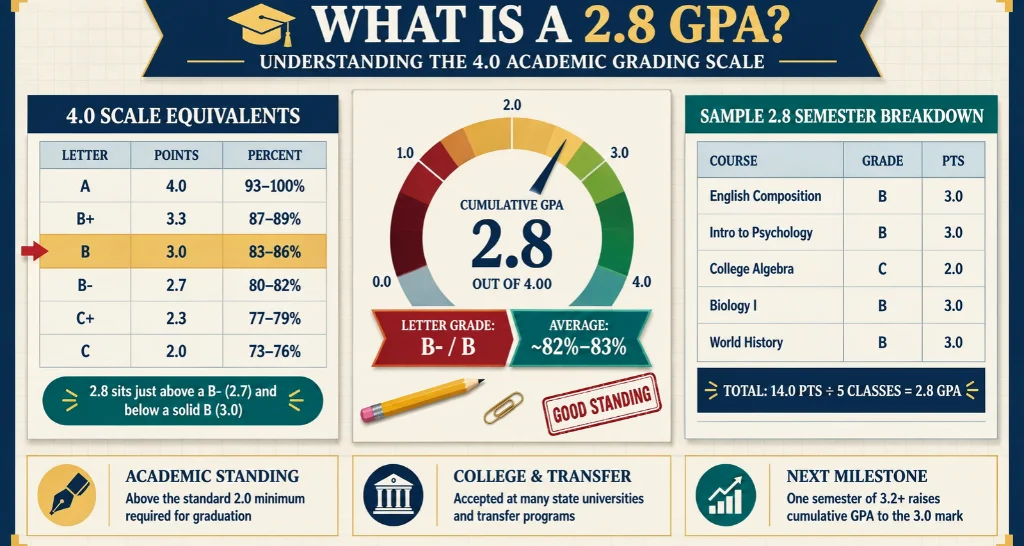
If you are wondering what is a 2.8 GPA, you are probably trying to understand where your grades stand. On a common unweighted 4.0 scale, 2.8 falls between a B- and B average. It can still leave you with college options, although admission chances depend heavily on each school.
Direct answer: A 2.8 GPA generally represents grades around the B- range on a standard U.S. 4.0 scale. It is below a straight-B 3.0 average but comfortably above a C-level 2.0 average. Your exact letter-grade or percentage equivalent can differ because schools use different grading systems.
2.8 GPA at a Glance
| Question | General answer |
|---|---|
| GPA scale | Usually discussed on a 4.0 scale |
| Closest letter-grade range | Around B- |
| Position compared with 3.0 | Slightly below a B average |
| College admission possible? | Yes, at many institutions |
| Competitive for highly selective colleges? | Usually difficult |
| Can it be improved? | Yes, especially with semesters remaining |
| Does every school calculate it identically? | No |
Key Takeaways
- A score of 2.8 usually sits near the B- range on a standard 4.0 scale.
- It does not automatically prevent you from attending a four-year college.
- Selective institutions often admit students with substantially stronger academic records.
- Weighted and unweighted averages cannot always be compared directly.
- Colleges may consider course difficulty, grade trends, essays, activities, and other factors.
- Improving future grades can raise your cumulative average, especially earlier in high school.
- Always check your own school’s grading policy before converting GPA into a percentage.
What Is a 2.8 GPA on a 4.0 Scale?
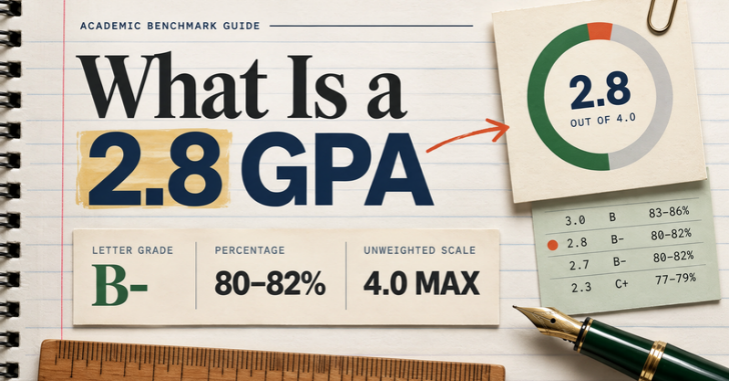
The answer to what is a 2.8 GPA starts with understanding how the common 4.0 scale works. An A normally receives about four grade points, while a B receives around three. A C is commonly worth about two points, although plus-and-minus values vary by school.
A 2.8 sits below a straight-B 3.0 average and above the common B- value of 2.7. That makes B- the closest simple letter-grade reference on many grading charts. The Princeton Review, for example, lists B- as 2.7 and B as 3.0.
Your transcript does not necessarily contain mostly B- grades, though. Several combinations of A, B, and C grades can produce the same cumulative average. Credit hours can also make some courses affect the calculation more than others.
Does a 2.8 Equal a B-?
A 2.8 is generally closest to a B-, but it does not literally mean every class earned that grade. GPA represents an average across courses rather than one individual score. Your actual transcript could contain grades above and below the B- range.
Published conversion charts also differ slightly between institutions and education websites. CollegeSimply places 2.8 within its B- range, while other charts may use different percentage boundaries. For that reason, your school’s official grading policy should be the deciding reference.
Percentage conversions deserve the same caution. Some sources place this average near 80% to 82%, while other charts use slightly higher figures. There is no single nationwide percentage conversion that every American school must use.
Is a 2.8 GPA Good?
Whether 2.8 is good depends on your goal, academic level, and the institutions you are considering. It represents solid passing performance and shows that many grades likely fall around the B range. It may still sit below the profile expected at more selective colleges.
A student aiming for an open-admission or moderately selective institution may have realistic choices. A student targeting an extremely selective university will usually face a steeper challenge. Admission officers also evaluate applicants within the context of their school and available coursework.
The number also means something different for a college student maintaining academic standing. Individual universities set their own standards for majors, scholarships, graduation, and graduate programs. You should therefore compare your record with the specific requirement affecting you.
Can You Get Into College With a 2.8?
Yes, college admission is possible with this academic record. Apply Notes that students in this range still have realistic four-year options. The available choices will depend on the colleges you select and the rest of your application.
Admission standards vary greatly across the United States. Some institutions admit many students whose GPAs fall around this range, while selective schools report much higher entering profiles. Search each college’s published freshman class data instead of relying on one national cutoff.
Your application can also contain information beyond a cumulative average. Colleges may review course rigor, recent grade trends, essays, activities, recommendations, and other required materials. Test policies also vary, so review each institution’s current admission requirements.
A smart college list usually contains several levels of selectivity. Include realistic options where your record fits the typical admitted-student range. You can then add reach schools without making your entire application strategy depend on them.
Weighted Versus Unweighted GPA Matters
An unweighted GPA normally measures grades on a scale that tops out around 4.0. A weighted system can award extra points for advanced courses. Honors, Advanced Placement, International Baccalaureate, or similar classes may receive additional weight.
That difference means two students displaying the same number can have different academic records. One student may report an unweighted figure, while another school reports weighted results. Colleges may also recalculate high-school grades using their own methods.
Before comparing yourself with admission statistics, determine which scale your school uses. Your counselor or transcript guide should explain the method. This prevents misleading comparisons between numbers produced under different grading systems.
What a 2.8 Means for College Applications
A cumulative average is only one piece of an application. Admissions teams may also consider whether your academic performance is rising or falling. Stronger junior or senior grades can provide useful evidence of improvement.
Course selection matters as well. A challenging schedule may provide context that a raw number cannot show. Still, difficult classes do not erase weak grades, so balance ambition with courses you can complete successfully.
Application costs can become another consideration when applying to several schools. Some students may qualify for application fee waivers under specific programs or institutional rules. Newssnaut’s guide to what a fee waiver means explains that term in plain language.
What About Scholarships?
Scholarship requirements vary even more than general admission requirements. Some awards establish a minimum GPA, while others consider financial need, activities, talent, or community involvement. A single number cannot determine your eligibility for every scholarship.
Many merit programs become more competitive as award amounts increase. Students near 2.8 should read every eligibility rule before assuming they cannot apply. Local organizations and institution-specific programs may use criteria beyond academic averages.
If a scholarship requires a 3.0 minimum, improvement could open another opportunity. Calculate what future grades would be necessary before setting that target. Your counselor can help determine whether the change is mathematically realistic.
How Can You Raise a 2.8 GPA?
Improvement becomes easier when you identify which classes are lowering your average. Review your transcript and current grades instead of treating every course equally. Focus first on subjects where better study habits can produce meaningful gains.
Use a simple improvement plan:
1. Attend consistently. Missing lessons can create gaps that affect later assignments and tests.
2. Complete every assignment. Small missing grades can damage an average faster than students expect.
3. Ask teachers for help early. Do not wait until the final weeks of a grading period.
4. Study on a schedule. Short, repeated sessions often work better than last-minute cramming.
5. Use tutoring when needed. Extra instruction can help when one subject repeatedly causes problems.
6. Track grades weekly. Regular checks make it easier to respond before problems become permanent.
7. Choose courses carefully. Build a schedule that challenges you without creating an unmanageable workload.
Your ability to raise a cumulative average depends on how many credits you have already completed. A freshman generally has more time to change the final number than a senior. College students with many completed credits may also need several strong semesters for a noticeable increase.
Example: How Grade Improvement Can Change the Picture
Imagine a student has mostly B- and B grades, with several C grades lowering the cumulative result. Replacing future C-level work with stronger B and A grades can move the average upward. The exact change depends on completed credits and the school’s calculation method.
Improvement also matters because admissions readers can see trends. A transcript that moves upward may tell a different story from one showing continued decline. That does not guarantee admission, but it provides useful context about recent academic performance.
Do not focus only on reaching an attractive round number. Improving your understanding of difficult subjects matters beyond the transcript. Stronger skills can make the first year of college easier once you arrive.
High School GPA Versus College GPA
High-school averages are commonly discussed in connection with undergraduate admission. Colleges compare applicants while considering the grading practices and courses offered at their schools. A 2.8 in high school therefore should be interpreted within that educational setting.
College GPAs can affect different decisions. They may influence academic standing, admission into certain majors, internships, scholarships, or graduate-school applications. Each university publishes its own rules, so there is no universal American threshold.
Graduate programs may establish requirements above this level. For example, the University of Pittsburgh’s Physics and Astronomy department lists 3.0 as its minimum for full-status graduate admission. Other programs can use different standards or review lower records under separate policies.
Should You Be Worried About a 2.8?
A 2.8 deserves attention if it falls below the requirements for your academic goal. It does not mean that your education has reached a dead end. The useful next step is comparing your record with specific admission, scholarship, or program requirements.
Students still in school should concentrate on factors they can change. Future grades, stronger study habits, improved attendance, and smarter course planning remain within your control. A counselor can also help you build a realistic college list around your current record.
If you are preparing applications, avoid measuring yourself against one highly selective university. Thousands of American colleges have different missions, student profiles, and admission approaches. Your goal should be finding institutions that match your record, finances, interests, and academic plans.
The Bottom Line
A 2.8 GPA generally places you around the B- range on a common 4.0 grading scale. It can limit access to highly selective programs, but it does not eliminate college opportunities. The meaning becomes clearer when you compare it with your school’s grading system and your target colleges.
If you still have semesters remaining, focus on consistent improvement instead of worrying about the number alone. Review individual college requirements and build an application list with realistic choices. You can also explore more educational explainers and practical guides on Newssnaut.
Frequently Asked Questions
What is a 2.8 GPA in letter grades?
For anyone asking what is a 2.8 GPA in letter-grade terms, B- is usually the closest simple comparison. A standard chart often places B- near 2.7 and B near 3.0. Your school may use a slightly different plus-and-minus scale.
What percentage is a 2.8?
There is no universal percentage conversion used by every American school. Many informal conversion guides place it around the low-80% range. Check your school’s published grading scale before treating any percentage as exact.
Is a 2.8 enough for college?
Yes, some four-year colleges admit students with academic records around this range. More selective schools may expect substantially higher averages from typical admitted students. Compare your record with each college’s recent admission data.
Can I raise a 2.8 to a 3.0?
It may be possible, especially when you still have many courses remaining. The required grades depend on completed credits and future credit hours. Students near graduation often need stronger grades because earlier coursework already carries significant weight.
Is a weighted 2.8 the same as an unweighted 2.8?
No, those figures can represent different academic performance. Weighted systems may award extra points for advanced classes, while unweighted systems usually use a 4.0 ceiling. Always identify the scale before comparing numbers.
