


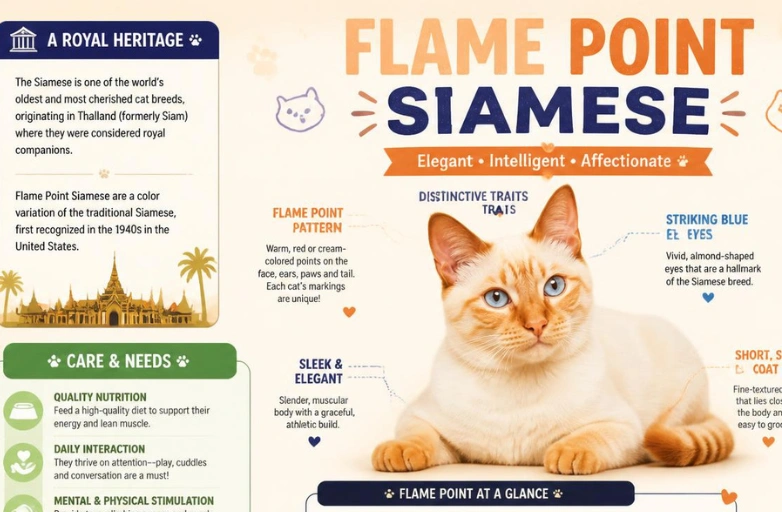
Direct answer: A flame point Siamese is a pale, blue-eyed colorpoint cat with red, orange, or apricot coloring on the ears, face, paws, and tail. In the United States, the name is used casually, but cat registries do not always classify these red-pointed cats in the same way.
If you have seen a cream-colored cat with blue eyes and orange-tinted ears, you may have heard it called a flame point Siamese. The name describes a striking color pattern rather than a universally agreed breed classification. That distinction matters when you are adopting, buying, or trying to understand a cat’s pedigree.
| Quick fact | What to know |
| Common name | Flame point or red point |
| Typical appearance | Pale body with red, apricot, or orange points |
| Eye color | Usually blue in pedigreed pointed lines |
| U.S. registry terminology | CFA places red points in the Colorpoint Shorthair breed |
| Temperament | Often social, vocal, intelligent, and people-focused |
| Coat care | Short coat with relatively simple grooming |
| Typical lifespan | Often well into the teens with good care |
| U.S. cost | Varies widely by adoption, pedigree, breeder, and documentation |
Key Takeaways
- “Flame point” and “red point” usually describe the same general red-orange pointed coloration.
- U.S. breed terminology depends on the registry, so the name alone does not prove pedigree.
- The pointed pattern comes from temperature-sensitive pigmentation.
- These cats often share the active, vocal, social personality associated with related colorpoint lines.
- Health history and responsible breeding matter more than unusual coat color.
- Adoption can cost far less than purchasing a documented rare-color kitten.
What Is a Flame Point Siamese?
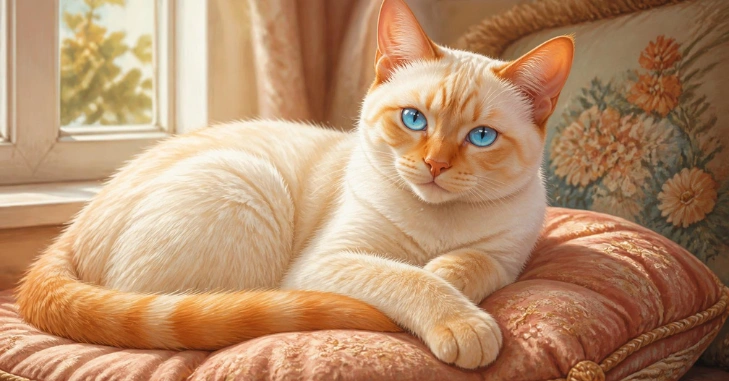
The term usually refers to a shorthaired colorpoint cat with a light body and reddish points. The Cat Fanciers’ Association recognizes only seal, chocolate, blue, and lilac as Siamese colors. CFA instead registers red-pointed cats of this type as Colorpoint Shorthairs, whose red-point standard ranges from bright apricot to deep red.
Flame point Siamese Other organizations use broader classifications, which is one reason owners encounter conflicting answers online. TICA records and awards have included red-point cats as Siamese, illustrating how registry terminology differs. For a U.S. owner, the safest approach is to check the specific registry listed on a cat’s pedigree rather than treating a color nickname as proof of breed.
This distinction is similar to other pet color labels that sound more breed-specific than they are. News Stast’s explainer on the difference between red-nose and blue-nose Pit Bulls shows how color terminology can easily become mixed with breed identity. In both cases, appearance is only one piece of the animal’s background.
Why Do Their Ears, Face, Paws, and Tail Turn Orange?
Pointed coloration is tied to a temperature-sensitive form of the TYR gene, which helps control pigment production. Research on domestic cats found a specific TYR variant associated with the classic pointed pattern. Cooler parts of the body can produce more visible pigment, while the warmer torso remains much lighter.
That temperature effect helps explain why kittens can look nearly white when they are born. Their point colors become easier to see as they mature, and the contrast may continue changing over time. The red or apricot pigment produces the warm “flame” appearance instead of the dark brown, gray, or chocolate points people often picture first.
A solid red point should not automatically be confused with a red lynx point. CFA describes solid red points as having bright apricot-to-red extremities, while red lynx points have noticeable reddish bars or tabby markings. Looking closely at the face, legs, and tail can therefore help distinguish the two patterns.
Personality and Temperament
Color does not guarantee personality, so two cats with almost identical coats can behave quite differently. Still, related Siamese and Colorpoint Shorthair lines are widely described as social, vocal, intelligent, active, and strongly interested in their people. CFA specifically describes Colorpoint Shorthairs as affectionate, vocal, active, and sometimes insistent.
TICA describes the related breed as lively, talkative, intelligent, and highly people-oriented. That means an owner should expect to provide interaction rather than treating this as a decorative, independent pet. Daily play, climbing opportunities, puzzle toys, and regular human attention can be especially useful for an energetic individual.
These traits can work well in families that enjoy an involved companion. A social cat may follow family members from room to room, vocalize for attention, or participate enthusiastically in play. A quieter household that prefers a highly independent pet may find that level of interaction demanding.
Care, Grooming, and Daily Enrichment
The short coat is one of the easier parts of ownership. Purina recommends weekly combing for shorthaired Siamese cats, which helps remove loose fur and maintain the coat. Nail care, dental care, clean litter boxes, and routine veterinary visits remain important even when the coat itself needs little work.
Mental stimulation deserves as much attention as brushing. Intelligent, active cats benefit from climbing towers, scratching posts, food puzzles, interactive toys, and predictable play sessions. Rotating toys can also make a familiar indoor space more interesting without requiring constant new purchases.
Feed a complete and balanced cat food appropriate for the animal’s life stage, body condition, and medical needs. Water should always be available, while portions should be adjusted with guidance from a veterinarian if weight begins changing. Coat color does not create a special nutritional requirement, so avoid diets marketed mainly around the rarity of the cat.
For more animal-related reading on the site, readers can explore the News Stast Pets section. The category provides a natural home for additional breed, behavior, and pet-care coverage.
Lifespan and Health Issues to Know
There is not a strong separate lifespan dataset for red-pointed cats as a color group. PetMD reports that Siamese cats average around 15 years and may live into their twenties, while lifespan varies with genetics, environment, nutrition, and preventive care. It is more useful to evaluate the individual cat’s health history than to assume that the point color determines longevity.
Some health conditions have been reported more often in related pedigreed lines. PetMD notes concerns including pica, asthma, dental problems, and retinal degeneration, while VCA reports a familial predisposition to amyloidosis in some Siamese family lines. These risks do not mean every red-pointed cat will develop them, but they make breeder health records and regular veterinary examinations valuable.
Watch for changes in appetite, breathing, vision, weight, drinking habits, or unusual chewing and eating behavior. Those signs can have many possible causes, so internet breed information should not replace an examination. A veterinarian who knows the cat’s medical history can decide whether testing or treatment is needed.
Are They Rare, and What Do They Cost in the United States?
Red-pointed cats are less common than the four traditional CFA-recognized colors, but “rare” can be misleading. Cats with similar coloring can appear in pedigreed lines, mixed ancestry, rescues, and ordinary domestic populations. Availability therefore depends heavily on whether you want a documented pedigree or simply love the appearance.
Current U.S. pricing also varies sharply. One recent pricing guide lists rescue adoption at roughly $100 to $300 and rare-color pedigreed kittens at roughly $1,500 to $3,000, although individual organizations and breeders may charge outside those ranges. The same guide notes that documentation, health screening, bloodline, and breeder reputation can affect the amount.
Price should never be treated as proof that a kitten is authentically pedigreed or responsibly bred. Ask to see registration information, veterinary records, health-testing documentation, and the purchase contract before paying a large deposit. A seller who relies mainly on words such as “rare” or “exclusive” without records deserves extra scrutiny.
How to Choose or Adopt One Responsibly
Start by deciding whether pedigree matters to you. If it does, ask which registry issued the papers and verify how that organization classifies red-point cats. If pedigree does not matter, shelters and rescues may offer visually similar cats whose personalities are already easier to evaluate.
When considering a breeder, focus on health and living conditions before color intensity. Ask about the parents, genetic or veterinary screening, vaccinations, socialization, return policies, and the age when kittens leave for new homes. Responsible placement should give you enough information to judge the cat’s welfare without pressure to make an immediate payment.
For adoption, remember that shelter breed labels are often based on appearance rather than documented ancestry. A cream cat with orange points and blue eyes can still be a wonderful companion without a pedigree proving its exact background. Temperament, health, household compatibility, and your ability to provide long-term care are more important than the label printed on an adoption listing.
Is This the Right Cat for Your Home?
This type of cat can suit someone who wants an interactive companion rather than a distant pet. You should be comfortable with vocalization, regular play, climbing, curiosity, and a cat that may seek frequent attention. Homes where people are available for daily interaction can be a particularly good match.
Think beyond appearance before making the decision. The pale coat and orange points may catch your attention first, but personality and care needs will shape daily life for many years. Meeting the individual cat and discussing its behavior with a breeder, foster home, or shelter gives you more useful information than color alone.
The Bottom Line
The appeal of this cat starts with its cream coat, warm orange points, and blue eyes, but its background is more interesting than the nickname suggests. U.S. registries differ on how red-pointed cats are classified, and appearance alone cannot prove breed ancestry. Understanding that distinction helps you make better decisions about adoption, breeder claims, care, and price.
Flame point siamese Choose the individual cat based on health, temperament, documentation, and compatibility with your household. Keep up with preventive veterinary care and provide plenty of social and mental stimulation once the cat comes home. For more pet and lifestyle explainers, continue exploring News Stast.
Frequently Asked Questions
Are flame-point Siamese cats rare?
They are less common than traditional seal, chocolate, blue, or lilac points in CFA Siamese lines. Similar red-pointed cats can still appear through several pedigreed and non-pedigreed backgrounds, so rarity depends on what definition you use. A documented pedigree is much harder to find than a cat that simply has the same general appearance.
Are red point and flame point the same thing?
In everyday pet terminology, the names are commonly used for the same reddish or orange point coloration. Breed registries generally prefer formal color terms such as “red point,” while pet owners frequently use “flame point.” The exact registration category still depends on the organization and pedigree involved.
Do their colors get darker as they age?
Point colors can become more noticeable as a kitten grows. The underlying pigmentation system is temperature-sensitive, so the cooler extremities develop stronger color than the warmer torso. Age, genetics, and individual variation can all influence how dramatic the final contrast becomes.
Do they have blue eyes?
Pedigreed Siamese and CFA Colorpoint Shorthairs are expected to have blue eyes under their respective breed standards. A cat with similar orange-point coloring but undocumented ancestry may not fit every formal breed characteristic. Eye color alone, therefore, cannot establish pedigree.
How long can a red-pointed cat live?
There is no reliable reason to assign a unique lifespan solely from the red-point coat color. Related Siamese cats commonly live into their teens, and some reach their twenties with appropriate care. Genetics, preventive veterinary care, nutrition, safety, and the individual animal’s health have a greater practical effect on longevity.
