


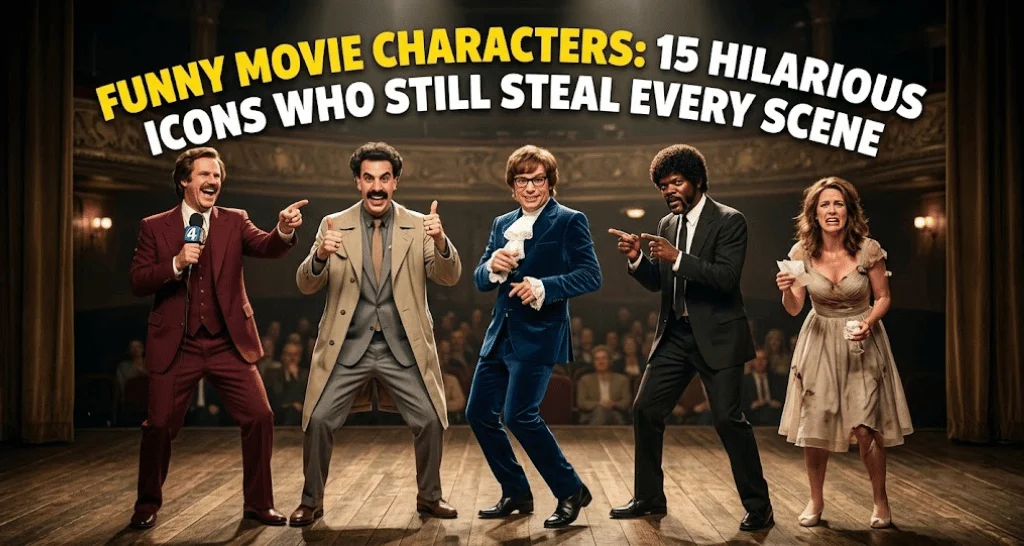
Some funny movie characters can make an ordinary scene memorable before the real joke even arrives. Their voices, expressions, strange logic, and perfectly timed reactions become as recognizable as the movies themselves. The strongest comedy characters stay funny because their personalities create humor, not just punchlines.
Direct answer: The funniest film characters combine memorable personalities, strong performances, and comedy that still works outside one scene. Favorites such as Frank Drebin, Ron Burgundy, Donkey, Alan Garner, and Derek Zoolander use different comedy styles. Their humor ranges from deadpan delivery and absurd confidence to physical comedy and complete social confusion.
Quick Guide to the Characters on This List
| Character | Movie or Series | Performer | Comedy Style |
|---|---|---|---|
| Frank Drebin | The Naked Gun | Leslie Nielsen | Deadpan absurdity |
| Ron Burgundy | Anchorman | Will Ferrell | Arrogant stupidity |
| Donkey | Shrek | Eddie Murphy | Fast-talking humor |
| Alan Garner | The Hangover | Zach Galifianakis | Social awkwardness |
| Derek Zoolander | Zoolander | Ben Stiller | Clueless confidence |
| Dr. Evil | Austin Powers | Mike Myers | Villain parody |
| Lloyd Christmas | Dumb and Dumber | Jim Carrey | Physical comedy |
| Regina George | Mean Girls | Rachel McAdams | Cutting social humor |
| Buddy | Elf | Will Ferrell | Innocent enthusiasm |
| Mrs. Doubtfire | Mrs. Doubtfire | Robin Williams | Improvisational comedy |
| Ace Ventura | Ace Ventura | Jim Carrey | Extreme physical humor |
| Inspector Clouseau | The Pink Panther | Peter Sellers | Comic incompetence |
| Napoleon Dynamite | Napoleon Dynamite | Jon Heder | Awkward deadpan |
| Borat | Borat | Sacha Baron Cohen | Social satire |
| Deadpool | Deadpool | Ryan Reynolds | Self-aware humor |
Key Takeaways
- Great comedy characters usually have a clear personality that naturally creates jokes.
- Physical comedy, deadpan delivery, satire, awkwardness, and absurd confidence can all work.
- Several characters remain popular because audiences recognize them by a single expression or mannerism.
- Comedy is subjective, so this list mixes different eras and styles instead of claiming one universal winner.
- Modern online humor often keeps older characters visible through clips, reactions, GIFs, and memes.
Why Funny Movie Characters Stay Memorable
The best comedy performances feel connected to the character, not pasted onto the script. Frank Drebin is funny because he treats ridiculous events with complete seriousness. Derek Zoolander gets laughs because his confidence never matches his understanding of the situation.
That character-first approach also explains why movie scenes become lasting internet jokes. Newssnaut’s guide to Friday memes and pop-culture humor shows how familiar screen moments gain new lives online. A recognizable reaction can remain useful decades after audiences first saw the original film.
Current comedy lists also show how broad audience tastes have become. Rankings feature slapstick stars beside animated sidekicks, satirical creations, and deadpan oddballs. That range makes a mixed list more useful than choosing characters from one comedy era.
15 Funny Movie Characters Worth Watching Again
1. Frank Drebin, The Naked Gun
Leslie Nielsen plays Frank Drebin with the seriousness of a detective in a grim crime drama. That straight-faced delivery makes every absurd misunderstanding much funnier. His refusal to recognize surrounding chaos creates one of cinema’s strongest deadpan performances.
The character works because Drebin rarely appears to know he is part of the joke. Ridiculous events happen around him, yet his expression barely changes. That contrast became a defining feature of The Naked Gun series.
2. Ron Burgundy, Anchorman
Ron Burgundy combines enormous confidence with an impressive lack of self-awareness. Will Ferrell plays him like a man convinced every sentence deserves attention. The gap between his self-image and reality creates most of the character’s humor.
His dramatic delivery also makes ordinary situations sound strangely important. Ron can turn workplace competition into something that feels like a national emergency. Few fictional news anchors are as instantly recognizable.
3. Donkey, Shrek
Eddie Murphy gives Donkey enough energy for several animated characters at once. He talks constantly, ignores social boundaries, and keeps following Shrek despite repeated complaints. His warmth prevents the nonstop chatter from becoming irritating.
Donkey also works as a perfect opposite to Shrek’s guarded personality. One wants silence, while the other treats silence as a problem. Their mismatched friendship drives many of the franchise’s funniest exchanges.
4. Alan Garner, The Hangover
Alan Garner turns social discomfort into an endless source of comedy. Zach Galifianakis plays him with strange confidence, unusual observations, and unpredictable emotional reactions. He often behaves like everyone else understands rules that nobody explained to him.
His funniest moments rarely require complicated setups. Alan can create tension by standing incorrectly, answering a question strangely, or misunderstanding a relationship. That awkward unpredictability helped make him the trilogy’s most identifiable character.
5. Derek Zoolander, Zoolander
Derek Zoolander approaches modeling with the seriousness of a world leader handling a crisis. Ben Stiller builds the humor around vanity, confusion, and total certainty. Derek almost never realizes how little he understands.
His famous poses work because the character believes they represent major artistic achievements. The audience sees something much less profound. That difference keeps the satire playful instead of making Derek simply unpleasant.
6. Dr. Evil, Austin Powers
Mike Myers turns the traditional supervillain into a needy, outdated, and strangely insecure boss. Dr. Evil wants dramatic respect but constantly loses control of the room. Even his elaborate plans can sound hilariously impractical.
The character also parodies older spy-movie villains without requiring viewers to know every reference. His gestures, pauses, and exaggerated seriousness communicate the joke immediately. That accessibility helped the character outgrow the films that inspired him.
7. Lloyd Christmas, Dumb and Dumber
Jim Carrey gives Lloyd Christmas a combination of optimism, foolishness, and remarkable physical energy. Lloyd regularly misunderstands simple situations without losing confidence. His terrible decisions somehow make him more cheerful instead of more cautious.
The friendship with Harry Dunne makes the character even stronger. Neither man consistently recognizes the other’s mistakes. Their shared confusion turns basic travel, dating, and conversation into extended comic disasters.
8. Regina George, Mean Girls
Regina George proves a comedy character does not need to be goofy. Rachel McAdams makes Regina funny through control, social precision, and ruthless observations. Her calm delivery often makes harsh lines land harder.
The character also works because the movie understands teenage social power. Regina can change a room’s mood with one sentence. Her influence makes the comedy sharper because the consequences feel recognizable.
9. Buddy, Elf
Buddy sees New York through the enthusiasm of someone discovering nearly everything for the first time. Will Ferrell commits completely to his innocence. That commitment lets the movie find humor without making Buddy cynical.
His reactions are funniest when other characters treat ordinary adult behavior as completely normal. Buddy treats routine experiences like celebrations or mysteries. The contrast gives Elf much of its lasting holiday appeal.
10. Mrs. Doubtfire, Mrs. Doubtfire
Robin Williams brings quick improvisation and physical comedy to the Mrs. Doubtfire persona. The disguise creates obvious complications, but Williams gives the character more than one recurring joke. His voices, reactions, and sudden improvisations keep scenes moving quickly.
The comedy also depends on Daniel Hillard maintaining an increasingly difficult deception. Each new problem requires another improvised explanation. That structure gives Williams repeated chances to shift between panic and confidence.
11. Ace Ventura, Ace Ventura: Pet Detective
Ace Ventura turns walking, talking, and entering a room into physical comedy. Jim Carrey exaggerates every movement until the character seems governed by different physical rules. The performance is intentionally excessive from the opening scenes.
Ace also possesses absolute faith in his unusual methods. He acts like the smartest detective in the room, even when everyone else looks confused. That combination gives the character a cartoon-like quality inside a live-action movie.
12. Inspector Clouseau, The Pink Panther
Inspector Clouseau approaches investigation with confidence that his abilities rarely justify. Peter Sellers makes small mistakes grow into complicated disasters. His commitment keeps the character from noticing how much damage he creates.
Clouseau became an important model for later incompetent authority figures in comedy. The audience often understands a situation long before he does. Watching him reach the wrong conclusion becomes part of the pleasure.
13. Napoleon Dynamite, Napoleon Dynamite
Napoleon Dynamite is funny because the movie rarely tells viewers when to laugh. Jon Heder delivers strange statements with flat confidence. His pauses and body language make everyday conversations feel unexpectedly unusual.
The character also avoids the energetic style found in many mainstream comedies. Napoleon can make silence, irritation, or a brief stare carry a scene. That low-key rhythm helped the movie develop a lasting cult audience.
14. Borat, Borat
Sacha Baron Cohen uses Borat to create uncomfortable social satire. The character’s apparent misunderstandings encourage other people to reveal their own assumptions. That method creates comedy from interactions rather than traditional scripted punchlines.
The style can be provocative, and not every viewer enjoys its discomfort. Still, Borat became one of the most recognizable satirical film creations of the 2000s. The character shows how comedy can depend on tension as much as jokes.
15. Deadpool, Deadpool
Deadpool treats superhero conventions like material for a running comedy routine. Ryan Reynolds uses quick remarks, direct audience addresses, and self-awareness throughout the films. The character frequently comments on the kind of movie he occupies.
That approach separates him from more traditional action heroes. Violence, romance, and superhero spectacle can all become joke material within seconds. His popularity also shows how comedy can thrive inside genres beyond pure comedy films.
What Makes a Movie Character Genuinely Funny?

A strong comic character needs more than good dialogue. Personality creates expectations, and filmmakers can then break those expectations at the right moment. The funniest performances often combine writing, timing, facial reactions, and a distinctive worldview.
Contrast also matters. Donkey becomes funnier beside Shrek, while Ron Burgundy benefits from colleagues who occasionally recognize his absurdity. Clouseau needs competent people nearby so audiences can measure the scale of his mistakes.
Relatability can matter even when the character is extreme. Audiences recognize embarrassment, misplaced confidence, social anxiety, jealousy, and stubbornness beneath the exaggeration. Those familiar emotions give ridiculous behavior something human to build upon.
Comedy also changes with culture and language. Internet slang, memes, and reaction images keep reshaping how audiences share humorous moments. Readers interested in online expressions can also explore Newssnaut’s guide to Snapchat slang and abbreviations.
Which Comedy Style Makes the Strongest Characters?
No single formula exists because different styles create different pleasures. Deadpan comedy rewards viewers who notice contrast, while physical comedy creates an immediate visual response. Satire depends more heavily on understanding the behavior or genre being mocked.
This helps explain why lists of beloved characters vary so widely. Community discussions mention everything from Lloyd Christmas to older spoof characters and unexpected comic performances. Humor depends heavily on personal taste and viewing history.
The strongest test may be whether the character remains identifiable without the complete plot. A voice, costume, posture, or reaction can sometimes be enough. Characters with that level of identity tend to remain quotable and shareable.
Frequently Asked Questions
Who are the most popular funny movie characters?
Popular funny movie characters include Frank Drebin, Ron Burgundy, Donkey, Alan Garner, Derek Zoolander, and Lloyd Christmas. Lists vary because humor remains subjective across generations. Recent rankings continue mixing classic comedy figures with newer film favorites.
What makes a movie character funny?
A comic character usually needs a clear personality, good timing, and believable reactions within the movie’s rules. Humor often comes from confidence, misunderstanding, awkwardness, exaggeration, or conflict with another personality. Great performances make those traits feel consistent instead of random.
Who is a funny animated movie character?
Donkey from Shrek remains one of the most recognizable animated comedy characters. Eddie Murphy’s vocal performance gives him speed, warmth, and relentless enthusiasm. His friendship with the quieter Shrek creates a dependable source of comic contrast.
Are the funniest film characters always from comedy movies?
No, humorous characters can appear in superhero, action, horror, fantasy, or adventure films. A serious story often uses one character to release tension. Deadpool shows how humor can even become the central identity of an action-heavy superhero story.
Why do older comedy characters remain popular?
Strong character comedy can survive changing trends because audiences remember personalities, not isolated jokes. Clips and memes also introduce older performances to viewers who never watched the original release. Current comedy rankings still include characters created many years apart.
The Characters We Keep Quoting
Comedy changes, but memorable characters give audiences something stronger than a temporary punchline. They create recognizable personalities that viewers can imitate, quote, and rediscover. The best examples can make people laugh before the character even finishes speaking.
This list covers several comedy styles rather than declaring one performer universally funniest. Your favorite may depend on age, taste, and the movies you grew up watching. That disagreement is part of what keeps comedy discussions entertaining.
For more humor, culture, entertainment, and everyday explainers, browse the Newssnaut homepage. Rewatch a favorite comedy afterward and focus on the character rather than the plot. You may notice how much of the humor comes from personality alone.
